

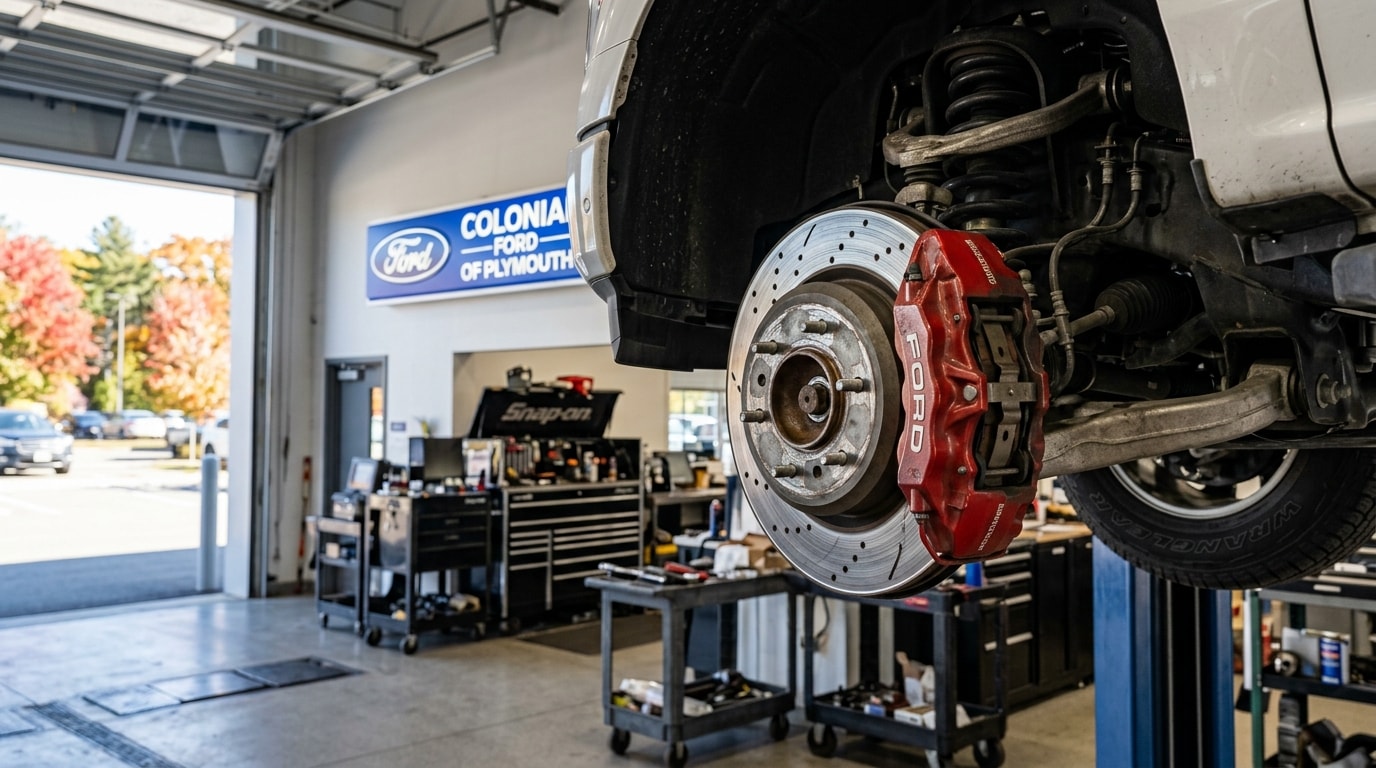
Ford F-150 brake pads require replacement every 30,000 to 70,000 miles, with original equipment Motorcraft brake pads typically lasting between 40,000 and 60,000 miles under standard driving conditions. Professional brake inspections should occur every 10,000 miles alongside scheduled tire rotations to ensure proper lining thickness and system operation.
Driving conditions in southeastern Massachusetts heavily influence how quickly friction materials degrade on full-size trucks. Regular stop-and-go commuting around Bridgewater places higher thermal stress on front calipers than steady highway cruising. Furthermore, trucks equipped with the 325-horsepower 2.7-liter EcoBoost V6 or the 430-horsepower PowerBoost hybrid experience varying deceleration dynamics—hybrids benefit from regenerative braking, which can extend physical pad lifespan, whereas heavy payload hauling increases mechanical wear.
The four-wheel antilock disc setup on the 2026 Ford F-150 relies on substantial hardware, featuring ventilated front rotors measuring nearly 14 inches in diameter and ventilated rear rotors measuring over 13 inches. Routine checks allow factory-trained technicians to catch uneven wear early, preventing rotor damage and maintaining optimal pedal feedback. For quick scheduling, local owners can give our service team a quick call at (508) 591-5242 or visit our Plymouth service center for a complete inspection.
Table of Contents
- What Are the Key Signs That Your Ford F-150 Needs New Brake Pads and Rotors?
- Are Ceramic or Semi-Metallic Brake Pads Better for a Ford F-150?
- Why Is Service Mode Required Before Changing Rear Brake Pads on a 2026 F-150?
- How Much Does F-150 Brake Service Cost and What Is the Fluid Change Interval?
- Common Questions About 2026 Ford F-150 Maintenance and Service Schedules
- Where Can You Get Official Ford F-150 Brake Service Near Plymouth?
What Are the Key Signs That Your Ford F-150 Needs New Brake Pads and Rotors?
The most clear warning signs that a Ford F-150 requires immediate brake service include high-pitched metallic squealing, harsh grinding sounds during deceleration, steering wheel vibration under braking, and a soft or spongy brake pedal. Drivers may also observe increased stopping distances or an illuminated dashboard brake warning indicator.
Audible cues are designed into friction materials as a built-in safety feature. When pad friction material wears down to approximately 3 millimeters, an integrated wear indicator contacts the spinning rotor, producing a distinct squeal. Ignoring this warning leads to metal-on-metal contact, where the steel backing plate carves deep grooves into the ventilated rotor face. This results in costly rotor replacement rather than simple resurfacing.
Subtle mechanical changes also signal friction degradation or hydraulic issues. Steering wheel pulsation usually points to thermal warping or uneven pad deposits across the rotor surface, often caused by heavy braking cycles during winter travel. In coastal areas like Wareham Center, winter road salt accelerates corrosion on caliper slider pins and pad retaining clips, causing pads to stick or drag against the rotor. When replacing worn components, fitting genuine factory hardware from our dedicated Ford parts department ensures exact tolerances, correct noise abatement shims, and long-term durability.
Are Ceramic or Semi-Metallic Brake Pads Better for a Ford F-150?
Semi-metallic brake pads are best suited for F-150 trucks used for heavy hauling and towing, offering superior heat dissipation and cold-weather bite, whereas ceramic brake pads are ideal for daily driving, offering whisper-quiet operation and minimal brake dust generation.
Selecting the right friction material depends directly on how the truck is used daily. Semi-metallic brake pads consist of metallic fibers mixed with synthetic compounds, giving them exceptional structural integrity under extreme temperatures. When pulling a heavy trailer with an F-150 rated for up to a 13,500-pound max tow rating powered by the 3.5-liter EcoBoost V6, semi-metallic compounds resist high-temperature brake fade during long downhill descents. The primary trade-off is increased rotor wear and higher levels of dark brake dust on the wheels.
Conversely, ceramic brake pads utilize dense ceramic compounds mixed with fine copper fibers. They perform exceptionally well during normal commuting, providing a smooth, predictable pedal response across wide ambient temperature swings. Ceramic pads generate fine, light-colored dust that does not adhere readily to aluminum wheels, and they operate much quieter than metallic alternatives. However, under sustained high-heat towing conditions, ceramic pads can transfer excess heat back into the hydraulic calipers and fluid.
Why Is Service Mode Required Before Changing Rear Brake Pads on a 2026 F-150?
Electronic brake service mode is mandatory before servicing rear brake pads on a 2026 F-150 because it electronically retracts the internal motorized screw mechanism inside the electric parking brake caliper. Compressing the caliper piston without activating service mode strips the internal actuator gears and causes permanent mechanical failure.
Modern full-size trucks utilize electric parking brake actuators mounted directly onto the rear caliper body. Unlike traditional cable-operated parking brakes, these units use an internal electric motor to turn a threaded ball-screw mechanism, pushing the piston against the rear ventilated disc to secure the vehicle. During regular pad replacement, the caliper piston must be pushed back into its housing to accommodate the thickness of fresh friction linings.
If a technician attempts to mechanically force or clamp the piston rearward while the electric actuator is engaged, the pressure destroys the plastic gear assembly and internal spindle threads. Placing the vehicle into electronic parking brake service mode through the instrument cluster vehicle settings menu or diagnostic scan tool commands the actuator motor to fully unwind the internal screw. Once retracted, the caliper piston can be safely compressed without hydraulic resistance or structural damage. Drivers can easily schedule an F-150 service appointment with factory-trained technicians who utilize official Ford diagnostic tools for flawless execution.
How Much Does F-150 Brake Service Cost and What Is the Fluid Change Interval?
Ford recommends replacing the brake fluid in an F-150 every 36 months regardless of mileage, while complete brake pad and rotor replacements typically range between $350 and $850 per axle depending on hardware specifications and trim options.
Brake fluid is hygroscopic, meaning it continuously absorbs moisture from ambient air through microscopic pores in hydraulic hoses and reservoir seals. Over three years, water contamination lowers the boiling point of DOT 4 brake fluid, increasing the risk of fluid vapor lock during hard braking events. Contaminated fluid also causes internal corrosion inside the anti-lock braking system valve body and brake master cylinder. A routine fluid flush clears out degraded fluid and moisture, restoring crisp hydraulic pressure.
Budgeting for routine maintenance involves both scheduled inspections and full hardware overhauls. Standalone brake system inspections generally cost between $40 and $100, though this fee is frequently bundled into regular scheduled maintenance passes. Front axle pad and rotor replacements generally run between $250 and $500, while rear service typically costs between $200 and $400. Owners looking to maximize maintenance value can check our available service and parts specials before booking their visit.
Common Questions About 2026 Ford F-150 Maintenance and Service Schedules
Q: How long do standard OEM Motorcraft brake pads last on a 2026 Ford F-150?
Original equipment Motorcraft brake pads on a 2026 Ford F-150 generally last between 40,000 and 60,000 miles. Actual lifespan depends on driving habits, road conditions, cargo loads, and whether the truck frequently hauls heavy trailers. Regular inspections every 10,000 miles ensure pads are wearing evenly.
Q: Should brake rotors always be replaced when installing new brake pads?
Rotors do not always require replacement with every pad change, provided they meet minimum thickness requirements and exhibit no deep scoring, heat cracks, or severe rust buildup. However, resurfacing or replacing worn rotors alongside fresh pads guarantees optimal contact, eliminates noise, and prevents premature pad wear.
Q: How does towing heavy loads impact F-150 brake component wear?
Towing heavy trailers generates extreme thermal energy during deceleration, accelerating friction wear and increasing rotor temperatures. Trucks frequently operated near their maximum towing capacity require more frequent brake inspections, high-temperature brake fluid flushes, and heavy-duty semi-metallic friction compounds to maintain safe stopping distances.
Q: Can severe winter road salt cause brake calipers to stick?
Prolonged exposure to road salt and moisture causes corrosion on caliper slider pins, pad mounting bracket ledges, and piston dust boots. This corrosion prevents pads from retracting fully after braking, leading to drag, excessive heat buildup, uneven pad wear, and reduced fuel efficiency if left unserviced.
Q: What happens if rear brake pads are compressed without engaging electronic service mode?
Attempting to force the rear caliper piston back without placing the electric parking brake into service mode strips the internal motorized drive gears and cracks the internal spindle assembly. This requires replacing the entire rear caliper and electronic actuator assembly, significantly increasing repair costs.
Where Can You Get Official Ford F-150 Brake Service Near Plymouth?
Certified Ford F-150 brake service is performed right here at Colonial Ford of Plymouth by factory-trained technicians using genuine OEM Motorcraft components.
Properly servicing a high-capability truck like the 2026 F-150 in Plymouth requires specialized knowledge, factory diagnostic tools, and precision components engineered specifically for Ford braking systems. Our service team utilizes specialized equipment to safely navigate electronic parking brake service modes, test hydraulic ABS module performance, and measure rotor runoff to exact factory specifications.
Whether your truck requires a routine 36-month brake fluid change, semi-metallic pads for heavy trailering, or a complete four-wheel brake overhaul, our technicians ensure every system meets factory safety standards. To arrange your next service visit, stop by our Plymouth service department or give our team a call at (508) 591-5242 to speak with a dedicated service advisor today.
© 2026 Colonial Ford of Plymouth. All rights reserved.