

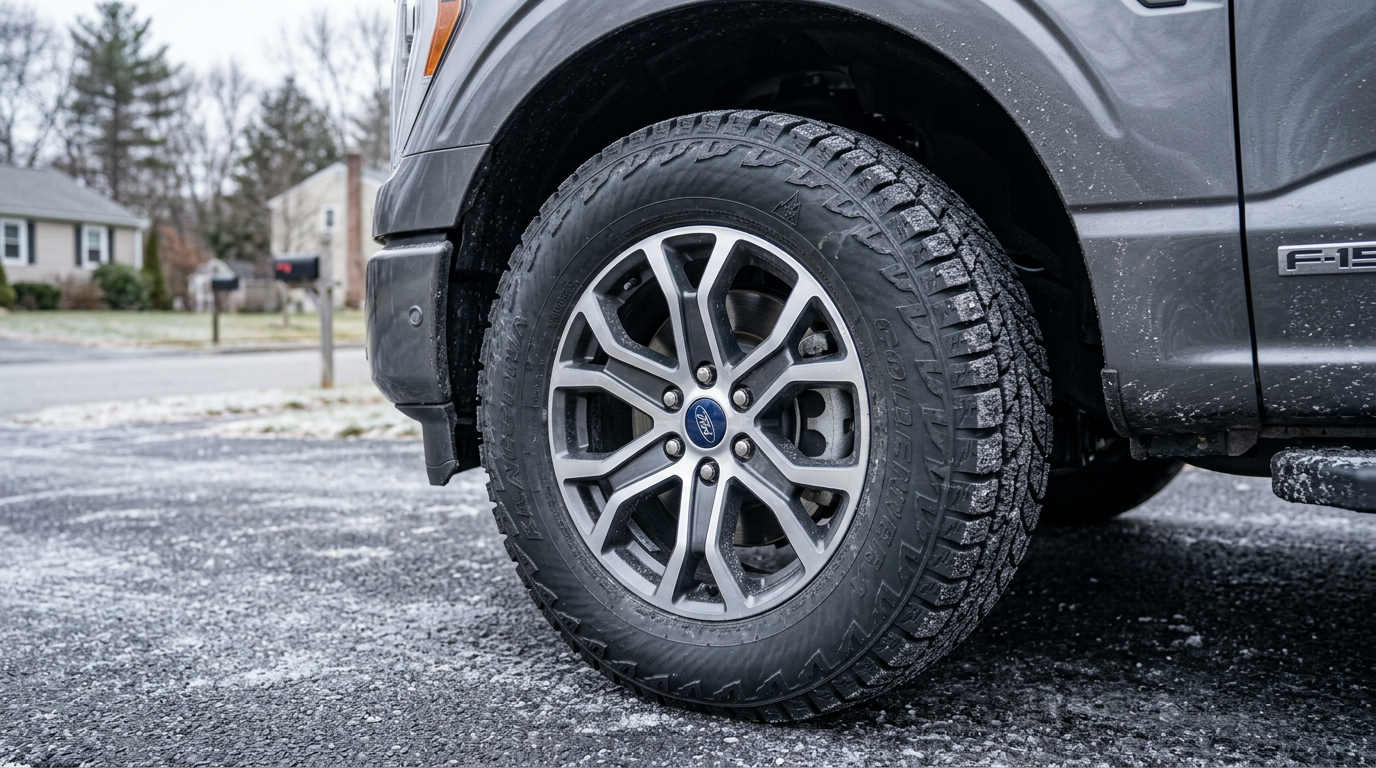
Dedicated winter tires and severe-snow-rated all-weather tires bearing the Three-Peak Mountain Snowflake symbol deliver the safest cold-weather traction for a Ford F-150. While standard all-season tires harden and lose elasticity when ambient temperatures drop below 45 degrees Fahrenheit, dedicated winter tread compounds remain flexible, allowing siping to bite into packed snow, ice, and slush.
Selecting the right tire for an F-150 requires balancing daily driving demands, winter severity, and vehicle setup. Heavy-duty truck applications demand a tire that maintains structural integrity under payload while resisting cold-weather cracking. Standard all-season tires engineered for summer and spring driving lack the specialized silica compounds necessary to grip sub-freezing asphalt. While four-wheel-drive systems send power to all four wheels during acceleration, drivetrain technology cannot generate traction on ice if the tire rubber has stiffened into hard plastic.
For drivers who experience freezing road conditions regularly, dedicated winter tires offer the shortest stopping distances and highest lateral stability. Alternatively, 3PMSF-rated all-terrain or all-weather tires provide a year-round compromise for truck owners who want severe snow capability without changing tires every spring and autumn.
To maintain peak performance and safety throughout the winter, our technicians can evaluate your current tread depth and rubber flexibility. You can visit our service facility on Pilgrim Hill Road for a professional tire inspection, or speak directly with an advisor by giving our team a quick call at (508) 591-5242.
Table of Contents
- What tire sizes, load ratings, and spare setups come standard on the Ford F-150?
- How do Continental, Bridgestone, and 3PMSF-rated tires perform in winter environments?
- Should you buy dedicated winter tires for driving an F-150 in coastal Massachusetts?
- How do cold temperatures and roads affect F-150 tire pressure and wheel alignment?
- How can I arrange Ford-authorized service for my F-150 near Plymouth or Marshfield?
- Frequently asked questions about Ford F-150 tire selection and maintenance
What tire sizes, load ratings, and spare setups come standard on the Ford F-150?
Standard Ford F-150 tire fitments range from 17-inch all-season tires on base trim levels to 20-inch or 22-inch options on luxury trims, with specific load indices chosen to match each payload and towing package.
Ford matches factory tire dimensions and ply construction directly to the vehicle’s Gross Vehicle Weight Rating (GVWR). When replacing factory tires, matching the original specification is essential for maintaining braking performance, speedometer accuracy, and electronic stability control calibration:
- Base Trim Fitments: The standard F-150 XL in two-wheel-drive configuration comes equipped with P245/70SR17 all-season tires.
- Mid-Tier & Off-Road Packages: The STX trim uses 265/60R18 all-season tires in 4x2 setups and 275/65R18 all-terrain tires in 4x4 configurations. When optioned with the FX4 Off-Road Package, the STX upgrades to LT265/70R18C all-terrain tires.
- High-Performance Off-Road: The F-150 Raptor features LT315/70R17 BFGoodrich All-Terrain T/A KO2 tires as standard equipment, with available 37-inch tire packages on specialized builds.
Replacement tires for most standard F-150 configurations must carry a load index between 112 and 116. Trucks configured with heavy-duty payload packages or high towing capabilities require Extra Load (XL) or Light Truck (LT) metric tires with a Load Range C or E rating. LT tires feature reinforced sidewalls that resist flex under heavy tongue weight when pulling trailers up to the maximum 10,400 lbs towing capacity.
Every F-150 comes from the assembly line with a full-size spare tire mounted under the truck bed. This spare tire matches the overall outer diameter of the factory road tires to prevent driveline binding when engaged in four-wheel drive. Drivers can confirm their vehicle's exact tire size, recommended cold inflation pressure, and maximum vehicle load limits by checking the official Tire Label located on the driver-side B-pillar. For genuine replacement fitments and factory-approved rubber, our Ford parts department stocks exact OEM tires engineered specifically for your truck.
How do Continental, Bridgestone, and 3PMSF-rated tires perform in winter environments?
Continental and Bridgestone truck tires designed for cold-weather service utilize flexible tread compounds and intricate siping patterns to maintain traction on frozen roads without compromising dry highway handling.
Tire performance in sub-freezing weather depends heavily on engineering standards and tread design. Models such as the Continental TerrainContact and Bridgestone Dueler series are engineered to address the distinct challenges of winter truck operation:
- Mud and Snow (M+S) vs. 3PMSF: An M+S branding simply indicates that a tire’s tread geometry features a minimum 25 percent open-to-flush ratio. It requires no physical traction testing.
- Three-Peak Mountain Snowflake Benchmark: The 3PMSF rating certifies that a tire has passed standardized ASTM testing on packed snow, achieving a light snow acceleration traction index at least 110 percent higher than a standard reference tire.
- Rubber Flexibility: Continental and Bridgestone incorporate high-silica polymers that remain pliable at sub-zero temperatures, preventing the tread blocks from glazing over slick surfaces.
- Slush Evacuation: Specialized circumferential grooves and open shoulder voids channel slush and standing water away from the contact patch to reduce hydroplaning risks.
While 3PMSF-certified all-terrain and all-weather tires deliver superior acceleration traction on packed snow compared to standard all-season tires, they do not replace dedicated winter tires in extreme ice conditions. The ASTM test for 3PMSF certification evaluates straight-line acceleration only; it does not measure lateral cornering grip or emergency braking distances on sheet ice. Dedicated winter tires retain a distinct safety advantage when cornering on hard-packed snow or glare ice.
Should you buy dedicated winter tires for driving an F-150 in coastal Massachusetts?
Deciding whether to install dedicated winter tires on an F-150 in coastal regions depends on your daily commute times, route elevation, and whether you tow heavy loads during winter months.
Coastal driving presents shifting weather challenges. Salt-air humidity, sudden ocean breezes, and frequent freeze-thaw cycles create black ice on bridges and slush on low-lying secondary roads. Standard all-season tires lose significant elasticity once temperatures hover consistently below 45 degrees Fahrenheit, lengthening stopping distances even on dry asphalt.
In coastal areas like Wareham Center, where roadside marshlands and tidal estuaries create localized dampness that freezes quickly overnight, dedicated winter tires offer an essential margin of safety. Dedicated winter rubber compounds use softer, cold-adapted polymers combined with thousands of microscopic tread biting edges (siping) designed to trap snow crystals and bite into clear ice.
Truck owners who utilize their F-150 for commercial hauling or early-morning commutes before snowplows treat secondary roads benefit significantly from a dedicated winter wheel-and-tire package. Conversely, drivers who stick primarily to well-salted highway corridors during midday hours often find that 3PMSF-rated all-weather or all-terrain tires provide sufficient seasonal traction.
Our service team frequently consults with local truck owners to evaluate whether their routine driving paths justify a seasonal tire swap or a year-round 3PMSF-rated tire build.
How do cold temperatures and roads affect F-150 tire pressure and wheel alignment?
Cold winter air reduces tire pressure by approximately 1 PSI for every 10-degree Fahrenheit decrease in ambient temperature, while winter road damage rapidly alters front-end wheel alignment.
When severe cold snaps strike overnight, drivers often wake up to a low tire pressure warning on their instrument cluster. A drop of 30 degrees in ambient temperature leads to an immediate loss of roughly 3 PSI. Operating an F-150 with underinflated tires causes multiple performance and financial penalties:
- Accelerated Tread Wear: Low inflation forces vehicle weight onto the outer shoulders of the tread, causing premature edge wear.
- Reduced Fuel Economy: Underinflated tires increase rolling resistance, pulling fuel economy below the factory rating of 17 city / 23 hwy mpg.
- Compromised Load Capacity: Reduced air pressure lowers the tire's structural weight rating, making it unsafe to carry heavy cargo in the bed, which offers up to about 53 cu ft of volume (about 53 cubic feet).
- Handling Degradation: Soft sidewalls create sluggish steering response during emergency evasive maneuvers.
Winter frost heaves and deep freeze potholes also take a severe toll on steering and suspension components. On commuter routes around Bridgewater, winter pavement breakup can easily knock an F-150 out of alignment after a single hard impact. Out-of-alignment wheels cause uneven tire scuffing, steering wheel pull, and premature tire replacement needs.
Checking wheel alignment annually or every 12,000 miles prevents uneven tread wear patterns. Setting tire pressure when the tires are cold—matching the precise inflation numbers printed on the B-pillar tire placard—ensures optimal contact patch safety all winter long.
How can I arrange Ford-authorized service for my F-150 near Plymouth or Marshfield?
Arranging factory-authorized service for your Ford F-150 involves selecting a certified dealership equipped with specialized truck bays, factory alignment machinery, and OEM tire inventory.
Factory-certified service ensures that your pickup receives maintenance performed by technicians who specialize exclusively in Ford drivetrains, electronic stability systems, and tire pressure monitoring protocols. Standard tire shops frequently lack the specialized vehicle lifting adapters or modern road-force balancing machinery needed to service light truck assemblies accurately.
When servicing your F-150 at an authorized dealership, every tire installation includes:
- Factory-Calibrated Mounting & Balancing: Utilizing high-precision equipment to eliminate high-speed drive-line vibrations.
- TPMS Sensor Reset: Re-pairing tire pressure sensors with the vehicle's onboard computer to ensure accurate cabin alerts.
- Suspension Inspection: Checking ball joints, tie rods, and shock absorbers for wear before completing wheel alignment.
- Ford OEM Fitment Verification: Ensuring replacement tires match exact load index and speed ratings specified by factory engineers.
You can view current promotional pricing and maintenance discounts by exploring our rotating service and parts specials before scheduling your visit. Certified Ford service protects your truck's durability, safety, and long-term resale value.
Frequently asked questions about Ford F-150 tire selection and maintenance
Q: Where can I locate the exact factory-recommended tire pressure for my truck?
The correct cold tire inflation pressure is printed on the official Tire and Loading Information label located on the driver-side B-pillar door edge. Do not use the maximum pressure figure stamped on the tire sidewall itself, as that number represents the maximum pressure the tire can structurally hold, not the engineered pressure for your F-150 model's specific weight distribution and suspension tuning.
Q: Can I install 35-inch tires on a stock F-150 without modifying the suspension?
Installing 35-inch tires on a stock Ford F-150 typically causes tire rubbing against the crash bars and inner wheel wells during full steering locks or suspension articulation. Fitting 35-inch tires cleanly generally requires installing at least a 2-inch to 2.5-inch front leveling kit or suspension lift to clear internal body structures and maintain safe steering clearance.
Q: Why does my low tire pressure light turn on during the first cold morning of autumn?
Tire pressure drops naturally as ambient air temperatures decrease, falling approximately 1 PSI for every 10-degree Fahrenheit temperature drop. A sudden cold night can lower your tire pressure by 3 to 4 PSI, crossing the threshold that triggers the onboard Tire Pressure Monitoring System alert. Checking and topping off tire pressure to specification each autumn resolves this issue.
Q: Does my Ford F-150 come with a full-size spare tire under the bed?
Yes, every 2026 Ford F-150 in Plymouth comes standard with a full-size spare tire mounted beneath the rear cargo bed. This spare tire is engineered to match the overall rolling diameter of your factory road tires, allowing you to drive safely without binding the four-wheel-drive system or damaging differential components if a roadside flat tire occurs.
Q: How frequently should I have the wheel alignment checked on my F-150?
Wheel alignment should be inspected at least once per year or every 12,000 miles. Alignment checks are also recommended after striking deep potholes, hitting curbs, or replacing tire sets. Regular alignment inspections prevent premature edge wear, maintain straight-line tracking, and protect expensive all-terrain or winter tire investments.
For factory-certified truck tire maintenance, mounting, or multi-point inspections, visit our Plymouth dealership address. You can reserve your preferred service time conveniently by scheduling a service appointment online, or speak directly with our service center desk by calling (508) 591-5242 today.
© 2026 Colonial Ford of Plymouth. All rights reserved.