

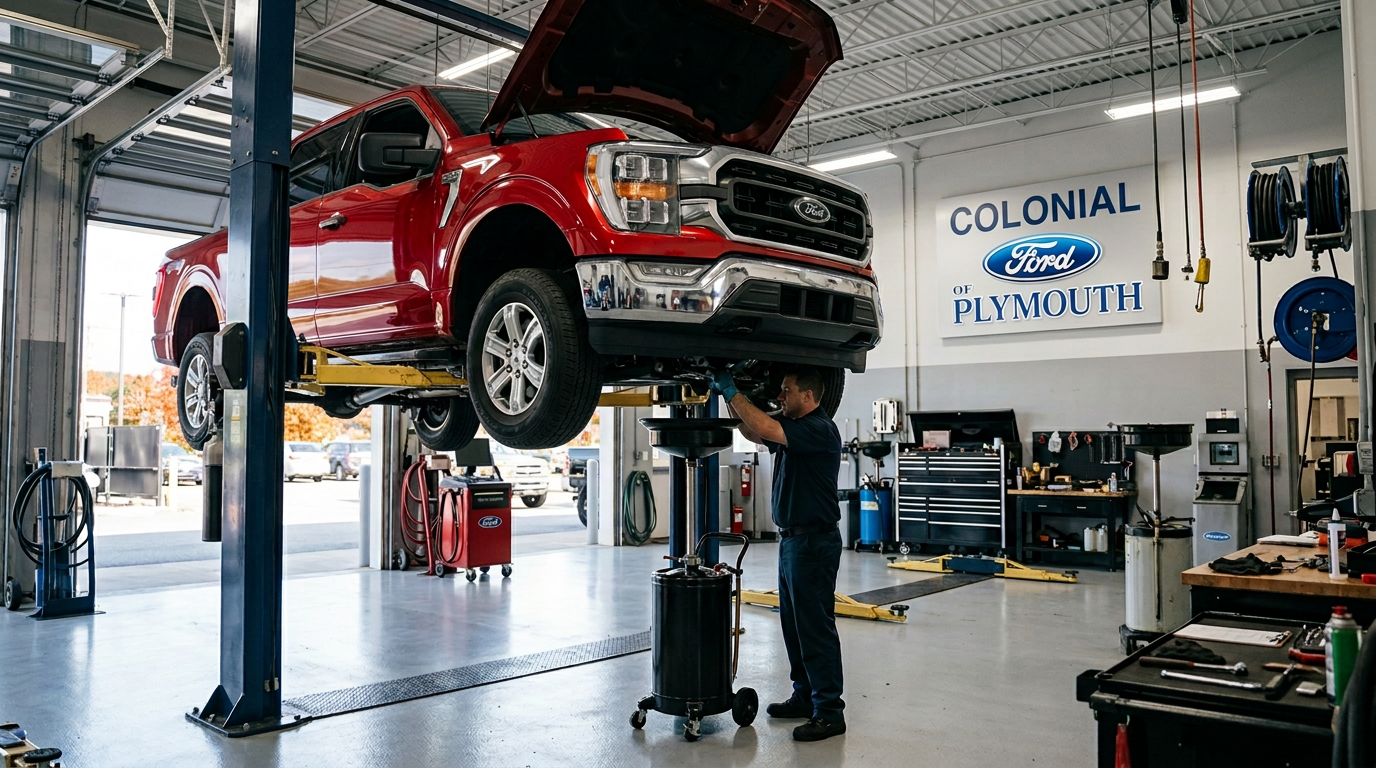
Ford F-150 oil service requirements depend on the engine design, driving habits, and oil specification, with standard service intervals ranging from 7,500 to 10,000 miles or 1 year using Ford-approved Motorcraft engine oil and a genuine oil filter. Severe driving conditions like frequent towing, heavy payload hauling, or extreme winter cold reduce this interval to 5,000 miles or 6 months. The truck's Intelligent Oil-Life Monitor continuously calculates engine temperature, operating hours, and load factors to alert the driver when service is necessary.
Proper engine lubrication is essential for maintaining the performance, fuel efficiency, and long-term durability of any Ford F-150 powertrain. Modern Ford engines feature precise internal tolerances, variable camshaft timing, and, in many models, twin-turbochargers that rely on clean motor oil to dissipate intense heat and prevent friction wear. Using the correct oil viscosity rating and oil filter design ensures that critical components receive immediate oil pressure during cold starts and sustained thermal protection under heavy work loads.
Adhering to factory-recommended oil specifications protects your vehicle's engine warranty, including the 5-year/60,000-mile powertrain warranty. Ford engine designs require oils meeting specific material standards—such as Ford WSS-M2C961-A1 for EcoBoost engines—which contain specialized detergent additives to combat carbon buildup on intake valves and turbocharger bearings. Neglecting oil service or using non-compliant lubricants can lead to oil sludge formation, reduced fuel economy below the EPA-rated 17 mpg city / 23 hwy, and premature wear on internal engine parts.
When scheduling routine maintenance, choosing an authorized service department ensures your truck receives factory-trained care, OEM Motorcraft fluids, and comprehensive system checks. You can schedule a service appointment online or give our team (508) 591-5242 a call to confirm recommended service intervals for your specific powertrain. For drivers visiting us in person, our service center location on Pilgrim Hill Road is fully equipped with specialized Ford diagnostics and high-capacity truck bays.
Table of Contents
- How often should you change the oil in a Ford F-150?
- What type of motor oil and how many quarts does a 3.5L EcoBoost Ford F-150 take?
- How do you reset the oil life monitor on a Ford F-150?
- Does routine dealer maintenance increase a Ford F-150 resale value?
- Where can I get a Ford F-150 oil change with convenient hours and service?
- Frequently Asked Questions About Ford F-150 Maintenance
- Keep Your Ford F-150 Running at Peak Performance
How often should you change the oil in a Ford F-150?
A Ford F-150 requires an oil change every 7,500 to 10,000 miles or 1 year under normal driving conditions, while trucks operated under severe duty require fresh oil every 5,000 miles or 6 months. The precise interval for your vehicle is tracked automatically by the onboard Intelligent Oil-Life Monitor, which notifies you via the instrument cluster display.
Ford F-150 OIL CHANGE INTERVAL GUIDELINES
| Driving Condition | Recommended Distance | Time Frame |
|---|---|---|
| Normal Commuting/Highway | 7,500 to 10,000 miles | 12 months |
| Moderate Towing/Cold | 5,000 to 7,500 miles | 6 months |
| Severe Duty/Heavy Haul | 3,000 to 5,000 miles | 6 months / 500 hrs |
Determining whether your driving falls into the normal or severe category depends on how you use your truck day-to-day. Normal driving includes regular highway cruising, light cargo hauling, and suburban commuting with minimal extended idling. In contrast, severe operating conditions apply if you routinely tow heavy trailers, haul loads near maximum payload capacity, drive extensively on unpaved roads, or operate in extreme sub-freezing winter weather.
Southeastern Massachusetts winters present unique stress factors for truck engines. Prolonged sub-freezing temperatures, frequent short-distance trips where the engine does not reach full operating temperature, and road-salt exposure increase the condensation of moisture and unburned fuel inside the crankcase. Commuters navigating daily routes in Bridgewater often experience stop-and-go traffic that accelerates oil breakdown faster than steady highway miles. Under these regional conditions, changing engine oil closer to the 5,000-mile mark helps maintain optimal viscosity and prevents internal corrosion.
Routine oil changes should always include replacing the oil filter with an OEM Motorcraft unit designed with an anti-drainback valve to prevent dry engine starts. If you perform your own maintenance or need replacement filters and fluids, our genuine Ford parts department carries factory-approved Motorcraft lubricants engineered specifically for Ford engines.
What type of motor oil and how many quarts does a 3.5L EcoBoost Ford F-150 take?
The 3.5L EcoBoost V6 engine in the Ford F-150 requires 6.0 quarts of motor oil including the filter replacement, and Ford specifies Motorcraft SAE 5W-30 synthetic blend or full synthetic oil meeting the WSS-M2C961-A1 material specification.
Ford F-150 ENGINE OIL CAPACITY & SPECIFICATIONS
| Engine Option | Oil Capacity | Viscosity Rating | Ford Spec |
|---|---|---|---|
| 2.7L EcoBoost V6 | 6.0 quarts | SAE 5W-30 | WSS-M2C961-A1 |
| 3.5L EcoBoost V6 | 6.0 quarts | SAE 5W-30 | WSS-M2C961-A1 |
| 5.0L Ti-VCT V8 | 7.7 quarts | SAE 5W-30 | WSS-M2C961-A1 |
The twin-turbocharged design of the 3.5L EcoBoost places specific mechanical demands on engine oil. Turbochargers operate at extremely high rotational speeds and internal temperatures, using engine oil not only for shaft lubrication but also for critical thermal cooling. Oils that fail to meet Ford specification WSS-M2C961-A1 can break down under turbo heat, leaving carbon deposits on shaft bearings and restrict oil passages over time.
While synthetic blend oil meets factory baseline standards, choosing full synthetic Motorcraft oil provides superior resistance to thermal breakdown, improved flow during sub-zero New England morning starts, and enhanced protection against low-speed pre-ignition in direct-injected turbocharged engines. Other engine configurations across the lineup have distinct capacity requirements; for example, the 2.7L EcoBoost twin-turbo V6 rated at 325 hp and 400 lb-ft of torque also takes 6.0 quarts, whereas the naturally aspirated 5.0L V8 rated at 400 hp and 410 lb-ft requires 7.7 quarts of oil.
Filling the engine with exactly 6.0 quarts ensures proper oil level without overfilling, which could cause crankshaft whipping and oil aeration. When changing oil on the 3.5L EcoBoost equipped with a SelectShift automatic transmission and up to 10,400 lbs towing capacity, technicians also inspect the drain plug seal and replace the oil filter canister O-rings to ensure a leak-free seal.
How do you reset the oil life monitor on a Ford F-150?
Resetting the Ford F-150 Intelligent Oil-Life Monitor requires navigating the instrument cluster display using the steering wheel directional controls, selecting Settings, opening Vehicle Information, highlighting Oil Life, and holding the OK button until the system resets to 100%.
- Turn the ignition key to the ON position without starting the engine (or press the START/STOP button once without depressing the brake pedal).
- Use the left-hand steering wheel directional pad to scroll through the main menu on the driver information screen.
- Select "Settings" from the menu options and press OK.
- Navigate to "Vehicle Information" or "Vehicle" depending on display software generation.
- Scroll down to highlight "Oil Life" or "Oil Life Reset".
- Press and hold the "OK" button on the steering wheel until the percentage bar fills and displays "100%" or "Reset Successful".
- Turn the ignition OFF to complete the process.
This system relies on mathematical algorithms tracking engine revolutions, oil operating temperature, towing hours, and ambient climate to estimate remaining lubricant life. Manually resetting the monitor without actually performing an oil change disrupts this tracking, causing the display to report 100% oil life when the oil inside the engine is actually degraded. Always complete the fluid and filter change before performing the cluster reset procedure.
Does routine dealer maintenance increase a Ford F-150 resale value?
Documented dealership maintenance records can increase the resale value of a Ford F-150 by 10% to 15% compared to trucks with incomplete or missing service histories. Prospective used truck buyers, commercial fleet managers, and dealership appraisers place a premium on vehicles with verified maintenance histories.
DEALER MAINTENANCE IMPACT ON RESALE & OWNERSHIP
| Resale Value Factor | Practical Benefit to Owner |
|---|---|
| Documented History | Proves timely oil changes and factory inspection intervals |
| OEM Parts Verification | Confirms use of Motorcraft filters and spec fluids |
| Warranty Protection | Maintains 5-year/60,000-mile powertrain coverage proof |
| Component Longevity | Prevents internal sludge, turbo wear, and timing stretch |
When a truck is serviced regularly at an authorized dealership, every oil change, tire rotation, and multi-point inspection is entered into the official Ford vehicle history database. This digital paper trail provides undeniable proof that the engine received correct fluid viscosities and genuine Motorcraft filters at factory-specified intervals. For a full-size pickup used for demanding tasks—such as launching boats or hauling heavy marine equipment around Wareham Center—verifiable maintenance proves that the powertrain was protected against severe-duty thermal stress.
Documented service records protect your 5-year/60,000-mile powertrain warranty coverage by providing immediate proof of compliance if a warranty claim ever arises. Furthermore, trucks maintained with genuine OEM parts retain higher trade-in values because dealership reconditioning teams do not need to perform catch-up maintenance or address deferred service issues before placing the vehicle on the pre-owned lot.
Where can I get a Ford F-150 oil change with convenient hours and service?
Authorized Ford service centers provide certified oil changes, multi-point vehicle checks, and complete factory maintenance performed by factory-trained technicians using genuine Motorcraft parts. Selecting an authorized facility ensures your truck is serviced according to exact Ford engineering procedures and technical service updates.
Ford WORKS MAINTENANCE PACKAGE INCLUSIONS
| Service Component | Action Performed |
|---|---|
| Synthetic Blend Oil Change | Up to 6.0 quarts of Motorcraft SAE 5W-30 |
| Motorcraft Oil Filter | OEM filter replacement with new O-rings |
| Tire Rotation & Pressure Check | Four-tire cross-rotation and pressure adjust |
| Multi-Point Inspection | Comprehensive brake, battery, and fluid audit |
| Fluid Top-Off | Washer, coolant, and brake fluid adjustment |
The Ford Works Maintenance Package bundles essential routine services into a single visit. This package includes a synthetic blend oil change, new OEM oil filter, tire rotation, pressure check, battery test, brake system inspection, fluid top-off, and a detailed multi-point report card. Combining tire rotation with your oil service promotes even tread wear across all four drive wheels, extending overall tire life and maintaining optimal traction during New England winter driving.
For added peace of mind, new Ford vehicles include manufacturer-backed emergency protection. If you ever experience an unexpected roadside issue, you can reach Ford Roadside Assistance: (800) 241-3673 for towing to the nearest authorized Ford service facility, battery jump-starts, fuel delivery, or flat tire assistance.
Before booking your next appointment, check our explore current service specials page for seasonal offers on oil changes, brake service, and battery replacements. When you are ready to visit, get directions to our facility or call our service advisors to reserve a time slot that fits your busy workday.
Frequently Asked Questions About Ford F-150 Maintenance
Q: What happens if I use the wrong oil viscosity in my Ford F-150 EcoBoost?
Using oil with an incorrect viscosity rating or non-compliant specification can cause improper hydraulic pressure in the variable camshaft timing actuators and reduced lubrication to turbocharger bearings. Heavier oils like 10W-40 fail to flow quickly during cold winter starts, leading to accelerated engine wear, while lighter oils without Ford specification approval may break down under high operating temperatures, voiding engine warranty coverage.
Q: Does the Ford Works Package include a full vehicle safety inspection?
Yes, the Ford Works Package includes a comprehensive multi-point inspection performed by factory-trained technicians. The check covers brake pad thickness, tire tread depth, suspension components, steering linkages, battery health, drive belts, cooling system hoses, exterior lighting, and all under-hood fluid levels to identify potential wear before it causes a breakdown.
Q: Can cold weather affect how quickly the Intelligent Oil-Life Monitor counts down?
Sub-freezing winter weather causes engine oil to take longer to reach optimal operating temperatures, leading to increased fuel condensation and moisture buildup inside the crankcase. The Intelligent Oil-Life Monitor tracks ambient cold starts, short-trip driving patterns, and warmup times, automatically adjusting the countdown to recommend earlier oil changes during harsh New England winters.
Q: How long does a standard Ford F-150 oil change take at a dealership?
A standard 2026 Ford F-150 oil change and multi-point inspection typically takes between 30 and 60 minutes when scheduled in advance. This timeframe allows technicians to drain degraded oil completely, replace the filter, rotate all four tires, inspect brake assemblies, perform a battery conductance test, and top off essential under-hood fluids.
Q: Is full synthetic oil necessary or is synthetic blend sufficient for general driving?
Motorcraft synthetic blend oil meets Ford factory baseline specifications and provides excellent protection for normal daily commuting and light truck duty. However, full synthetic oil offers superior thermal resistance for turbocharged EcoBoost engines, better low-temperature flow during frozen morning starts, and enhanced breakdown resistance for trucks used frequently for heavy towing or commercial workloads.
Keep Your Ford F-150 Running at Peak Performance
Maintaining a consistent oil change schedule is the single most effective way to protect your Ford F-150 powertrain, preserve factory warranty coverage, and maximize long-term resale value. Whether your truck requires standard maintenance under the Intelligent Oil-Life Monitor or severe-duty care for heavy towing, utilizing factory-approved Motorcraft lubricants and OEM oil filters keeps your engine running smoothly for miles to come.
Our factory-certified service center is equipped with high-capacity bays, advanced diagnostic tools, and OEM replacement parts engineered specifically for your truck. To schedule your next routine maintenance visit or consult with a service specialist about your truck's specific needs, schedule a service appointment online today.
© 2026 Colonial Ford of Plymouth. All rights reserved.