

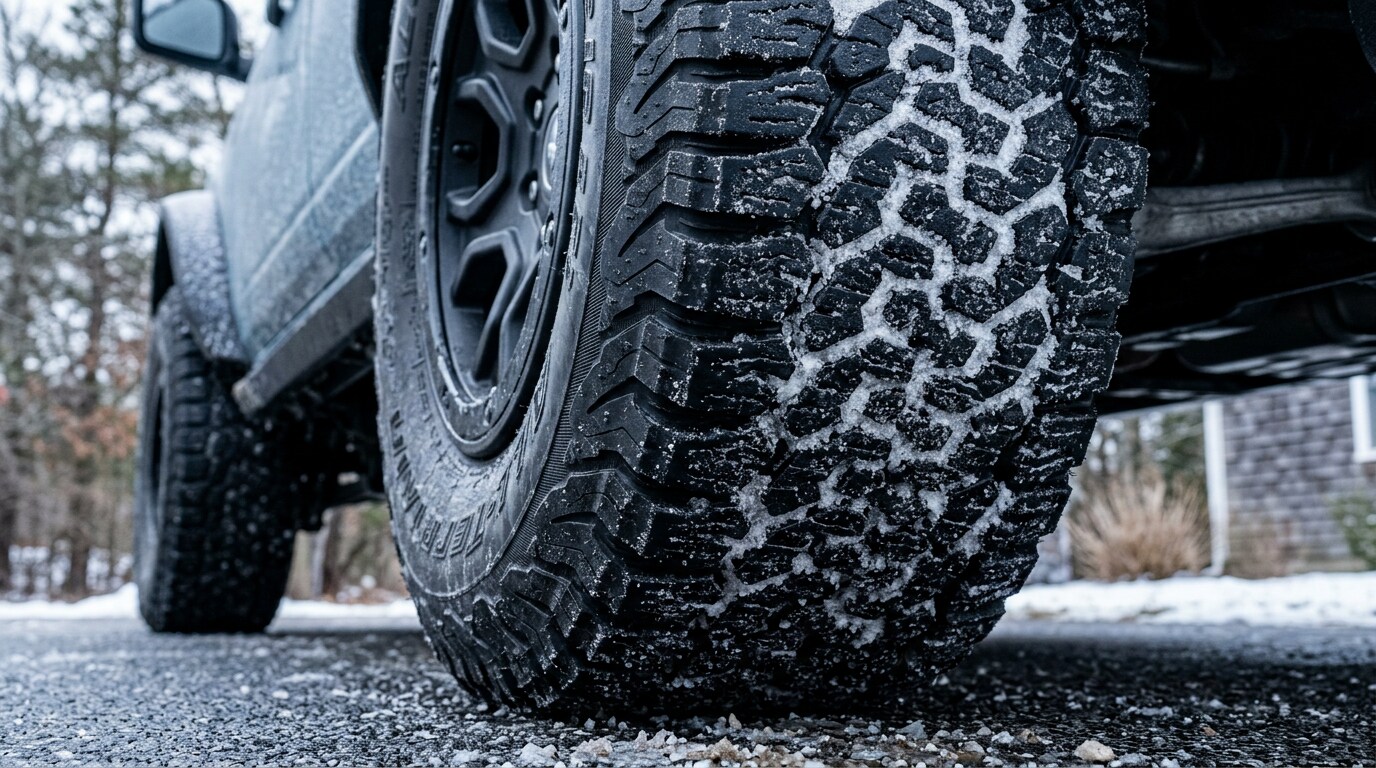
Dedicated winter tires and severe-snow-rated all-terrain tires carrying the Three-Peak Mountain Snowflake (3PMSF) symbol handle winter road conditions best on a Ford Bronco. While standard factory tires stamped solely with Mud and Snow (M+S) clear light slush, 3PMSF-certified tires feature specialized hydrophilic rubber compounds and dense siping. These compounds remain pliable below 45 degrees Fahrenheit, providing substantially shorter stopping distances, controlled lateral stability, and dependable grip over packed snow, black ice, and freezing road salt.
Winter driving demands more than just aggressive tread depth. Standard all-terrain rubber compounds begin hardening once ambient temperatures drop below 45 degrees Fahrenheit. As the tread blocks stiffen, the tire's contact patch loses elasticity, leading to reduced mechanical keying against cold asphalt and slick frost. In contrast, dedicated winter tires and winter-focused all-terrain tires utilize high-silica tread compounds engineered to stay flexible in sustained sub-freezing weather. For drivers navigating local winter conditions, choosing a tire that maintains chemical grip is just as critical as having mechanical tread voids.
Understanding tire sidewall designations prevents common winter performance compromises:
- M+S Rating: Indicates an open geometric tread pattern with a minimum 25 percent void-to-lug ratio designed to channel mud and soft snow, but it requires no standardized cold-weather traction testing.
- 3PMSF Certification: Awarded only after a tire demonstrates at least 10 percent better traction than an industry reference tire in an objective acceleration test on medium-packed snow.
- Siping Density: Severe-snow tires incorporate hundreds of microscopic, zigzag cuts inside the tread blocks that flex to trap snow against snow, which creates superior friction compared to rubber sliding directly over ice.
Cold winter conditions bring freezing precipitation, prolonged sub-zero snaps, and heavy road-salt applications that leave a slick brine over highway corridors. Drivers commuting through Bridgewater along icy morning routes benefit from tires that clear slush without caking. Our service department at Colonial Ford of Plymouth helps owners evaluate cold-weather tire options matched to factory wheel specifications. You can plan your visit using our service center location details, or discuss winter tire packages by giving our technicians a quick call today.
Table of Contents
- What Tire Sizes Come Factory Standard on Ford Bronco and Bronco Sport Models?
- How Do Full-Size Bronco Tires Differ from Bronco Sport Tires?
- Can You Fit 35-Inch Tires on a Standard Bronco, and How Can Crash Bars Affect Inspection?
- Should You Replace and Rotate the Full-Size Spare on a Ford Bronco?
- When Should You Rotate Ford Bronco Tires or Switch to Seasonal Tires?
- Common Questions About Ford Bronco and Bronco Sport Tires
- How to Check Ford Bronco Tire Availability and Installation at Colonial Ford
What Tire Sizes Come Factory Standard on Ford Bronco and Bronco Sport Models?
Factory standard tire sizes for the full-size 2026 Ford Bronco in Plymouth range from 30-inch passenger-rated tires up to 37-inch extreme off-road tires, while the 2026 Ford Bronco Sport uses crossover-specific sizes between 28.5 inches and 29.5 inches in overall diameter. Ford engineers each trim's original equipment tire to complement its specific suspension tuning, transfer case gearing, and curb weight.
On the full-size, body-on-frame Ford Bronco, standard fitments align with dedicated off-road capability packages. The Big Bend trim typically rides on 255/75R17 tires (approximately 32 inches tall), delivering balanced road manners and trail cushioning. Stepping up to the rock-crawling Badlands trim introduces LT285/70R17 tires (a 33-inch outer diameter) built with reinforced sidewalls to handle sharp trail debris. Full-size models equipped with the factory Sasquatch Package receive LT315/70R17 tires measuring 35 inches in diameter, while the range-topping Raptor features high-clearance 37x12.50R17 rubber mounted on wide, beadlock-capable wheels.
The unibody Ford Bronco Sport employs a compact architecture that relies on passenger or light crossover tire construction. Standard trims such as the Big Bend use 225/65R17 all-season tires tuned for low rolling resistance and quiet highway travel. The retro-styled Heritage trim incorporates 225/65R17 all-terrain rubber with more aggressive shoulder lugs, and the Outer Banks trim features 225/60R18 wheels with a lower aspect ratio for crisp steering response. For rugged utility, the Badlands and models equipped with the Sasquatch Package come fitted with 235/65R17 all-terrain tires that increase ground clearance and off-pavement bite.
Replacing factory tires with the correct load range, speed rating, and diameter preserves the accuracy of your speedometer, transmission shift points, and electronic stability systems. You can order original equipment replacements and factory-approved all-terrain designs directly through our dealership parts counter to ensure proper fitment for your vehicle's specific package.
How Do Full-Size Bronco Tires Differ from Bronco Sport Tires?
Full-size Ford Bronco tires differ from Ford Bronco Sport tires primarily in carcass construction, load capacity, overall diameter, and sidewall stiffness. The full-size Bronco utilizes heavy-duty Light Truck (LT) tires engineered for body-on-frame trucks with curb weights exceeding 4,500 to 5,000 pounds, whereas the Bronco Sport uses passenger (P-metric) or Euro-metric crossover tires tailored for a lightweight unibody chassis.
Tire construction dictates how each vehicle manages pavement, payload, and trail obstacles:
- Internal Ply Construction: Full-size Bronco LT tires use thicker, heavy-gauge steel belts and reinforced polyester casing plies (frequently Load Range C, Load Range D, or Load Range E) to resist sidewall punctures and impacts. Bronco Sport tires use Standard Load (SL) or Extra Load (XL) passenger casings built to minimize unsprung weight and road noise.
- Operating Pressures: Full-size LT tires require higher air volume and specific cold inflation pressures (typically 35 to 40 psi on the street) to support vehicle weight, while retaining the capacity to air down to 15 to 20 psi on soft trails. Bronco Sport tires operate within standard passenger car pressures (typically 32 to 34 psi) and are not engineered for extreme low-pressure bead retention.
- Sidewall Flex: The tall sidewall of a 33-inch or 35-inch truck tire flexes over rocky terrain and absorbs deep ruts, whereas the shorter sidewall on a Bronco Sport provides precise handling and stable tracking on asphalt.
Mounting an LT-rated truck tire on a Bronco Sport would result in a harsh ride, reduced fuel economy, and poor suspension damping due to excessive unsprung mass. Conversely, placing a standard passenger tire on a full-size Bronco could compromise safety, as passenger casings lack the ply strength required for heavy vehicle loads, trail abuse, and full-size towing applications.
Can You Fit 35-Inch Tires on a Standard Bronco, and How Can Crash Bars Affect Inspection?
A standard, non-Sasquatch Ford Bronco can fit 35-inch tires without a suspension lift only if the factory front and rear crash bars inside the front wheel wells are removed or replaced with aftermarket high-clearance crash bar kits. However, modifying or removing crash bars requires careful consideration of Massachusetts vehicle safety inspection standards and bumper height guidelines.
Factory crash bars are bolted to the frame horns forward and aft of the front tires on non-Sasquatch full-size Broncos. Their primary engineering purpose is to deflect front-wheel intrusion into the passenger footwell during a small-overlap frontal collision. When mounting a 35-inch tire—such as a 315/70R17 or 35x12.50R17—the outer edge of the tread contacts these frame extensions during medium-to-full steering lock or suspension compression. Factory Sasquatch models do not come with these bars; Ford fits modified body mounts and wider flares from the factory to provide the necessary tire clearance.
Regarding annual Massachusetts safety inspections, state regulations specify that vehicles must maintain structural bumpers and required safety equipment. While factory crash bars are supplemental collision-management structures rather than the primary structural bumper beam, an inspection station can reject a vehicle if tire modifications cause the tread to protrude outside the vehicle's fender flares or if sharp metal frame edges are exposed. If crash bars are removed to accommodate 35-inch tires, installing high-clearance, certified replacement brackets preserves supplemental frame protection while eliminating tire rub.
Whenever you alter wheel offset or tire diameter, recalibrating the anti-lock brake module and powertrain control module is necessary to maintain proper automatic emergency braking and stability control functions. You can schedule an appointment with our certified service team to evaluate tire clearances, speedometer recalibration, and state inspection compliance.
Should You Replace and Rotate the Full-Size Spare on a Ford Bronco?
You should include the spare tire in a five-tire rotation pattern and replace all five tires simultaneously when installing a new set on a full-size Ford Bronco. Because the full-size Bronco carries an exterior-mounted, matching spare wheel and tire, incorporating it into routine rotations prevents mechanical driveline binding and extends the usable tread life of your entire set by roughly 20 percent.
Four-wheel-drive systems, locking differentials, and electronic transfer cases are sensitive to variations in rolling circumference between individual wheels. If four tires wear down over 35,000 miles while the fifth sits unused on the rear carrier, the diameter discrepancy between a worn tire and a brand-new spare can reach 3/8 of an inch or more. Mounting that unused full-size spare alongside worn tires during a puncture scenario forces the differential spiders and transfer case clutches to constantly slip to compensate for differing axle rotational speeds, creating excess heat and premature drivetrain wear.
The proper maintenance sequence for a four-wheel-drive vehicle with a matching spare is a rearward cross five-tire rotation:
- Move the spare tire to the right rear wheel position.
- Move the right rear tire to the left front position.
- Move the left front tire to the left rear position.
- Move the left rear tire to the right front position.
- Move the right front tire to the spare carrier.
In the event of an unexpected puncture on the road, manufacturer-backed roadside care provides immediate support. Ford vehicles include roadside protection that connects you to factory-authorized assistance. For flat-tire changes, towing to an authorized service facility, or genuine replacement parts, you can contact Ford Roadside Assistance: 1-800-241-3673, and our service team can coordinate receiving your vehicle to remount or balance your wheels.
When Should You Rotate Ford Bronco Tires or Switch to Seasonal Tires?
Ford Bronco and Bronco Sport tires should be rotated every 5,000 to 7,500 miles, or at every scheduled engine oil service, while seasonal winter tires should be installed in late autumn when daily ambient temperatures consistently fall below 45 degrees Fahrenheit. Adhering to these intervals prevents aggressive all-terrain tread blocks from developing uneven heel-and-toe wear or cupping.
Because all-terrain tires feature deep, blocky tread voids, they are particularly prone to irregular wear when neglected. Front tires endure heavy scrubbing and lateral steering loads during tight turns, while the rear axle delivers primary propulsion torque. Regular rotations distribute these distinct mechanical forces evenly across all tread blocks, keeping road noise low and preserving wet-braking performance over the lifespan of the tire set.
For seasonal tire swaps, timing is dictated by temperature rather than snowfall. In coastal and southeastern Massachusetts communities, nighttime temperatures often drop below freezing by mid-November. Installing 3PMSF-certified or dedicated winter tires before the ground freezes ensures your vehicle has optimal braking traction during sudden early-season slush storms. In the spring, switch back to all-season or standard all-terrain tires once temperatures regularly stay above 50 degrees Fahrenheit, as warm asphalt accelerates tread wear on soft winter rubber compounds.
Routine tire inspections also safeguard long-term vehicle health. Winter road treatments throughout Middleborough Center accelerate salt accumulation around wheel hubs, valve stems, and aluminum rims. Having our technicians inspect your tire pressure monitoring sensors and clean wheel mounting surfaces during every seasonal changeover prevents slow bead leaks and ensures proper lug nut torque.
Common Questions About Ford Bronco and Bronco Sport Tires
Q: What is the minimum legal tread depth for tires in Massachusetts?
Massachusetts inspection regulations mandate a minimum tread depth of 2/32 of an inch across the major tread grooves. For wet and winter conditions, all-terrain and winter tires require at least 4/32 to 5/32 of an inch to effectively evacuate slush, water, and packed snow without hydroplaning.
Q: Why does my tire pressure monitoring warning light turn on during the first cold morning?
Tire pressure drops approximately one pound per square inch (psi) for every 10-degree Fahrenheit drop in ambient temperature. When winter temperatures plunge overnight, the contracting air inside your tires trips the vehicle's pressure sensors until the air is topped up to the factory specification on the driver-side door jamb.
Q: Can a suspension leveling kit allow 37-inch tires on a non-Raptor Bronco?
A simple leveling kit is not enough to clear 37-inch tires on a standard Bronco without rubbing during trail articulation. Safely running 37-inch tires requires a complete suspension lift, high-clearance fender flares, crash bar removal, re-geared axle ratios, and reinforced steering components to handle the added rotational mass.
Q: Can I run different tire brands or tread patterns on the front and rear axles?
Mixing different tire brands, tread patterns, or wear levels is not recommended on all-wheel-drive or four-wheel-drive vehicles. Mismatched tire construction alters rolling resistance and traction levels between axles, which can confuse electronic traction management systems and put unnecessary strain on the transfer case.
Q: How do I know if my all-terrain tires have severe snow capability?
Check the outer sidewall of your tire for an embossed mountain outline with a snowflake inside it, known as the Three-Peak Mountain Snowflake (3PMSF) symbol. If the sidewall only reads "M+S," the tire meets basic tread void requirements for mud and snow but has not undergone standardized testing for cold-weather braking and acceleration.
How to Check Ford Bronco Tire Availability and Installation at Colonial Ford
Selecting the ideal replacement tire for your Ford Bronco or 2026 Ford Bronco Sport in Plymouth depends on your driving habits, seasonal weather demands, and off-road requirements. Our factory-trained technicians at Colonial Ford of Plymouth help you match approved tire sizes, correct load ranges, and specialized winter compounds to your vehicle's exact trim and package specifications.
We stock original equipment tires and heavy-duty all-terrain options designed specifically for Ford four-wheel-drive and all-wheel-drive systems. Whether you need an OEM replacement, a seasonal changeover, or a complete five-tire rotation and wheel balance, our service center provides specialized equipment to handle large wheel and tire assemblies. Contact our service advisors by giving us a quick call to verify in-stock tire inventory, or use our dealership address and directions to visit our dedicated tire facility at 11 Pilgrim Hill Rd, Plymouth, MA 02360.
© 2026 Colonial Ford of Plymouth. All rights reserved.