

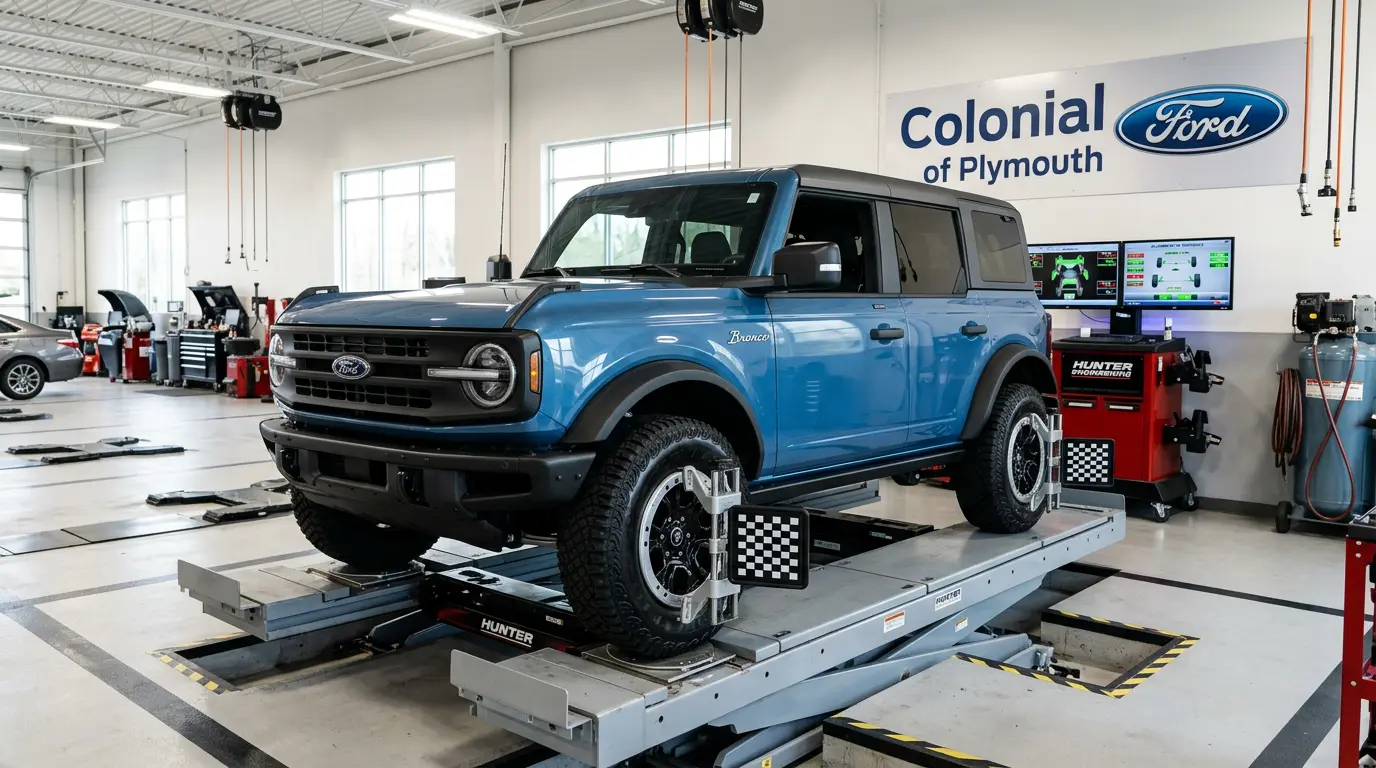
Proper wheel alignment is a fundamental aspect of vehicle maintenance that directly influences tire longevity, fuel economy, and overall driving safety. When your Ford leaves the factory, its steering and suspension systems are calibrated to highly precise geometric specifications. These settings govern how your tires contact the road surface, ensuring that your vehicle tracks straight and handles predictably. Over time, daily driving stresses, structural wear, and road imperfections can gradually shift these components out of their designated tolerances.
Three primary angles are measured and adjusted during a professional alignment:
- Camber: The inward or outward tilt of the tire when viewed from the front of the vehicle.
- Caster: The forward or backward tilt of the steering axis when viewed from the side, which influences steering returnability and high-speed stability.
- Toe: The direction the tires point relative to the vehicle centerline when viewed from directly above, resembling being pigeon-toed or duck-toed.
When these angles deviate from factory specifications, your tires no longer roll flat against the pavement. Instead, they drag at slight angles, creating excessive friction and heat. This mechanical drag accelerates tire wear and forces your powertrain to work harder, which can noticeably decrease your fuel economy. Staying proactive with routine suspension checks is the most effective way to protect your investment in premium rubber and maintain the refined driving dynamics engineered into your vehicle.
If you suspect your vehicle is tracking incorrectly or if you simply want to establish a baseline inspection, you can easily find us on the map. For turn-by-turn navigation, view our Plymouth service center directions, or speak directly with one of our service advisors by giving us a quick call at (508) 591-5242 to discuss your vehicle's specific symptoms.
Table of Contents
- What Are the Early Warning Signs That Your Ford Needs an Alignment?
- Can Hitting a Pothole Instantly Ruin Your Suspension Alignment?
- Comparing Alignments: 4WD Ford F-150 Versus 2WD Models
- What Is a Steering Angle Sensor Reset and Why Is It Crucial for Modern Ford Safety?
- How Long Does a Professional Wheel Alignment Take at the Dealership?
- Common Questions About Ford Wheel Alignment Services
- Trust Colonial Ford for Your Next Precision Alignment
What Are the Early Warning Signs That Your Ford Needs an Alignment?
Recognizing the early indicators of suspension misalignment can prevent minor steering issues from developing into costly tire replacements or suspension repairs. One of the most common warning signs is a distinct lateral pull, where the vehicle drifts toward one side of the road when you temporarily relax your grip on the steering wheel. This is often accompanied by an off-center steering wheel. If you are driving straight down a flat highway but your steering wheel is rotated several degrees to the left or right, your front-end geometry is out of tolerance.
Tire tread wear patterns offer highly reliable diagnostic clues. Misalignment typically manifests as rapid, uneven wear on specific sections of the tire tread. For example, excessive negative camber causes the inner edge of the tire to wear down to the cords while the outer edge remains thick. Toe-in or toe-out misalignment creates a feathering pattern across the tread block, which you can feel by sliding your hand flat across the tire.
Ignoring these early warning signs places continuous, uneven stress on your entire steering linkage. Tie rod ends, ball joints, and wheel bearings are forced to operate at angles they were not designed to tolerate, leading to premature wear of these critical components. If our technicians discover that worn suspension components are preventing a successful alignment, we can source factory-spec replacement parts directly from our authorized Ford parts department to restore your vehicle's structural integrity.
Can Hitting a Pothole Instantly Ruin Your Suspension Alignment?
Southeastern Massachusetts is notorious for severe seasonal temperature swings, which inevitably lead to deep asphalt fractures and sudden potholes. Hitting a single deep pothole at highway speeds can instantly deliver enough kinetic energy to bend steel suspension parts, sheer alignment pins, or force adjustable eccentric bolts completely out of position. This sudden impact immediately ruins your wheel alignment and can damage your wheels and tires.
The severity of the damage depends largely on your speed, the depth of the hole, and the angle of impact. A hard strike can bend a steering knuckle, distort a control arm, or damage a tie rod end. Even if the structural metal components do not bend, the violent upward force can slip the adjustment sleeves, immediately throwing your toe or camber angles out of specification.
For drivers commuting through Bridgewater, where local residential roads and campus routes often hide deep ruts after winter thaws, a sudden pothole strike is a common source of alignment trouble. If you experience a harsh impact followed by a sudden vibration, a crooked steering wheel, or a persistent pull, the vehicle should be inspected promptly. Continuing to drive with severe, impact-induced misalignment can rapidly destroy a tire within a few hundred miles and compromise your ability to perform emergency maneuvers safely.
Comparing Alignments: 4WD Ford F-150 Versus 2WD Models
The alignment process for a full-size pickup truck is highly dependent on its drivetrain configuration. A four-wheel-drive Ford F-150 utilizes a completely different front suspension and axle architecture compared to its two-wheel-drive counterpart. These physical differences require distinct technician specifications and mechanical adjustment procedures to ensure optimal driving dynamics.
On a 4WD Ford F-150, the front end accommodates half-shafts, a front differential, and CV joints. The presence of these heavy-duty drive components restricts the physical range of motion for certain suspension adjustments. Technicians must carefully balance front-end toe and caster settings to account for the torque load delivered through the front axles when 4WD is engaged. Conversely, a 2WD model features a lighter, less complex front-end assembly with a wider range of adjustability for camber and caster, allowing for a more straightforward mechanical correction.
Furthermore, many 4WD trucks are used for towing or hauling heavy payloads, which alters the rear ride height and changes the steering geometry at the front. Our technicians utilize specialized alignment databases that contain the precise factory tolerances for every specific truck configuration, cab style, and wheelbase. This ensures that whether your truck is configured for maximum utility or daily commuting, its steering geometry is calibrated exactly to its physical design.
What Is a Steering Angle Sensor Reset and Why Is It Crucial for Modern Ford Safety?
On modern Ford vehicles, a wheel alignment is no longer a purely mechanical procedure. Vehicles equipped with advanced driver assistance systems rely on a network of electronic sensors to monitor vehicle dynamics. The steering angle sensor is a vital component of this system, continuously measuring the exact physical angle of the steering wheel and reporting that data to the onboard computer.
The steering angle sensor works in tandem with key safety features:
- Electronic Stability Control: Compares your steering input with the vehicle's actual path to prevent skidding.
- Lane-Keeping Assist: Uses steering angle data to help keep your vehicle centered within lane markings.
- Pre-Collision Assist: Calculates potential collision paths based on steering direction and vehicle speed.
When a technician performs a mechanical wheel alignment, they physically change the angle of the wheels relative to the steering column. If the steering angle sensor is not electronically recalibrated and reset to zero after these mechanical adjustments, the vehicle's computer will believe the steering wheel is turned even when the vehicle is traveling completely straight. This discrepancy can cause the stability control system to intervene unexpectedly, disable your lane-keeping assist, or trigger warning lights on your dashboard. A professional alignment at an authorized dealership always includes this crucial digital calibration.
How Long Does a Professional Wheel Alignment Take at the Dealership?
A standard two-wheel or four-wheel alignment typically takes between 45 and 60 minutes to complete. However, this timeframe assumes that the vehicle's suspension components are in good working order and that the adjustment sleeves and bolts are free of heavy rust or corrosion. If a technician encounters seized fasteners or discovers worn ball joints that must be replaced before an alignment can be performed, the service will naturally take longer.
Modern alignment equipment utilizes high-definition digital cameras and wheel-mounted targets to measure your vehicle's geometry down to a fraction of a millimeter. The physical adjustments are made by hand, with the technician carefully turning adjustment sleeves while watching live measurements on a digital screen. For newer Ford vehicles, the process also requires connecting a diagnostic scanner to perform the electronic steering angle sensor reset, which adds a few minutes to the overall service time.
To ensure your vehicle receives prompt attention and to minimize your wait time, scheduling an appointment in advance is highly recommended. Our service department is fully optimized to handle these precision measurements efficiently, getting you back on the road with minimal disruption to your day.
Common Questions About Ford Wheel Alignment Services
Q: How often should I have my Ford's wheel alignment checked?
We generally recommend having your alignment checked every 12,000 miles or once a year, whichever comes first. However, if you frequently drive on rough roads, commute through construction zones, or notice any pulling or uneven tire wear, you should have it inspected sooner. Routine checks are often performed during tire rotations to ensure your suspension remains within factory tolerances.
Q: What is the difference between a two-wheel and a four-wheel alignment?
A two-wheel alignment, also known as a front-end alignment, only adjusts the front wheels' camber, caster, and toe. This is typically reserved for older vehicles with solid rear axles. A four-wheel alignment adjusts all four wheels and is necessary for all modern Ford SUVs, crossovers, and passenger cars equipped with independent rear suspensions, ensuring that the rear wheels track perfectly behind the front wheels.
Q: Can a bad alignment cause my steering wheel to vibrate?
While misalignment can occasionally cause a minor steering wheel pull or a slight drift, a distinct vibration in the steering wheel or seat is usually caused by out-of-balance tires or a bent wheel. However, because a hard impact can cause both tire imbalance and suspension misalignment, we recommend having both systems inspected if you experience a persistent vibration after hitting a road hazard.
Q: Why should I choose a dealership over a generic repair shop for an alignment?
Our dealership utilizes Ford-specific diagnostic software and specialized alignment racks designed to calibrate your vehicle's exact steering geometry. We also perform the mandatory steering angle sensor resets required for your vehicle's advanced safety systems, which generic shops may lack the equipment to handle. You can easily schedule your service online and check our current service and parts specials for seasonal maintenance opportunities.
Trust Colonial Ford for Your Next Precision Alignment
Maintaining proper wheel alignment is one of the most effective ways to protect your tires, optimize your fuel economy, and preserve the precise handling of your Ford. At Colonial Ford of Plymouth, our team of factory-trained technicians possesses the specialized training, diagnostic equipment, and genuine OEM parts required to keep your vehicle operating exactly as the manufacturer intended. We understand the unique driving demands of southeastern Massachusetts, from highway commutes to navigating seasonal road hazards.
Whether you are noticing a slight pull on your daily commute or want to ensure your vehicle is ready for a long road trip, our service team is here to assist you. If you are coming from Middleborough Center, our service center is easily accessible via major local routes, providing a convenient destination for professional maintenance. We invite you to experience our commitment to quality care, transparent communication, and efficient service.
To plan your visit, you can get directions to our dealership located at 11 Pilgrim Hill Rd, Plymouth, MA 02360. If you prefer to speak with a service advisor first to discuss your vehicle's alignment or to schedule an inspection, please contact us directly by calling (508) 591-5242 today.
© 2026 Colonial Ford of Plymouth. All rights reserved.