

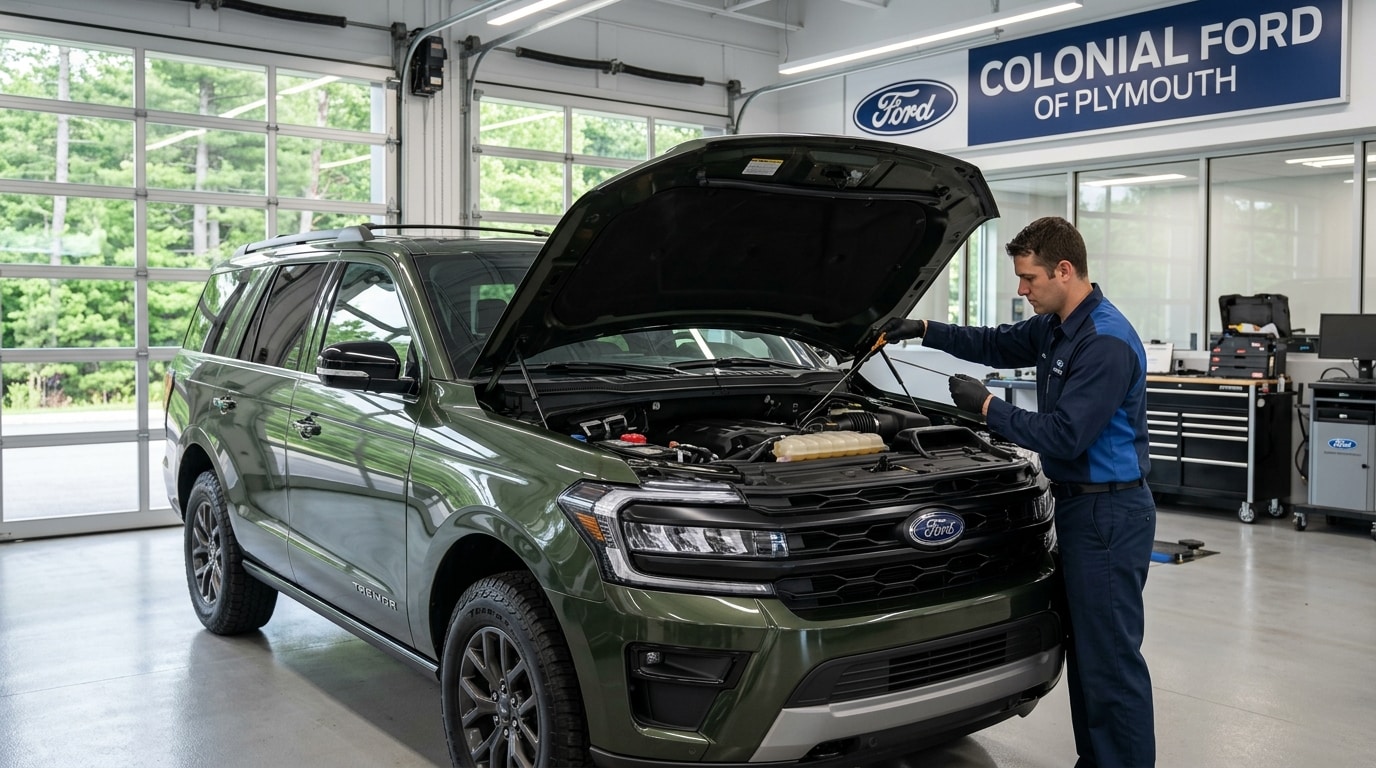
Ford factory scheduled maintenance includes synthetic blend or full synthetic engine oil and filter changes, tire rotations, comprehensive brake system inspections, fluid level checks and top-offs, and multi-point safety inspections. Depending on elapsed mileage or time, factory schedules also incorporate cabin air filter replacements, engine air filter replacements, brake fluid flushes, spark plug swaps, and long-term transmission and coolant fluid services.
During a standard service appointment, factory-trained technicians execute a structured routine designed to address high-friction mechanical components and critical safety systems. The core service center visit combines fresh engine oil and a high-efficiency filter with a tire rotation to equalize tread wear across all four wheels. Technicians test fluid levels for the windshield washer system, power steering, engine cooling reservoir, and hydraulic brakes, topping off fluids with OEM-specified formulations whenever necessary.
Every scheduled visit includes a thorough multi-point inspection. Technicians visually inspect key chassis components, including steering linkages, drive shafts, constant-velocity boots, exhaust systems, and suspension struts. Electrical health is verified through a 12-volt battery load test that measures cold-cranking power and terminal cleanliness. Brake pads, calipers, lines, and rotors are measured for wear tolerances to ensure reliable stopping power.
Drivers visiting our Plymouth service center location at 11 Pilgrim Hill Rd, Plymouth, MA 02360 receive detailed inspection reports outlining current component conditions and upcoming service needs. To speak directly with a service advisor regarding your vehicle's specific maintenance history, give our team a quick call at (508) 591-5242.
Table of Contents
- What Is the Recommended Maintenance Schedule for Ford Vehicles at 30,000, 60,000, and 90,000 Miles?
- How Often Does a Ford Need an Oil Change Under the Intelligent Oil-Life Monitor?
- What Scheduled Maintenance Do Ford EVs Require Compared to Gas Vehicles?
- How Does Regular Scheduled Maintenance Affect the Reliability of Ford Vehicles?
- Which Parts of Ford Factory Maintenance Can Be Done at Home Versus Professional Service?
- Where Can I Get Ford Factory Scheduled Maintenance and Warranty Service Near Bridgewater?
- Common Questions About Ford Factory Scheduled Maintenance
- Schedule Your Ford Factory Service Interval at Colonial Ford of Plymouth
What Is the Recommended Maintenance Schedule for Ford Vehicles at 30,000, 60,000, and 90,000 Miles?
Ford's major milestone service intervals occur at 30,000 miles, 60,000 miles, and 90,000 miles to replace wearing filters, inspect critical mechanical systems, and execute essential fluid services before performance degrades. These comprehensive visits build upon routine oil changes and tire rotations by adding targeted filter replacements, brake fluid checks, spark plug inspections, and drive belt evaluations.
At the 30,000 miles interval, the factory schedule mandates replacing the engine air filter to maintain proper air-to-fuel ratios and engine breathing. Technicians also swap the cabin air filter—which is typically scheduled every 20,000 miles to 30,000 miles—to clear trapped pollen, dust, and environmental debris from the climate control system. A detailed inspection of the fuel system, steering components, suspension ball joints, and braking hardware ensures early wear patterns are caught before causing mechanical friction.
The 60,000 miles service interval repeats all baseline filter and inspection services while introducing closer evaluations of drive belts, cooling hoses, and braking hydraulic systems. Ford guidelines specify flushing and replacing hydraulic brake fluid every 3 years regardless of mileage, making the 60,000-mile mark a common alignment point for this critical safety service. For vehicles driven under severe operating conditions—such as continuous trailering or extended idling—spark plug replacements move up to the 60,000-mile service visit.
Reaching 90,000 miles triggers a comprehensive multi-point overhaul inspection. Technicians evaluate serpentine belts for micro-cracking, inspect heat-stressed cooling lines, check differential and transfer case fluid levels on four-wheel-drive models, and prepare the powertrain for its upcoming 100,000 miles spark plug and initial coolant change thresholds. Adhering to these major milestone intervals maintains factory efficiency and protects engine component longevity.
How Often Does a Ford Need an Oil Change Under the Intelligent Oil-Life Monitor?
Under Ford’s Intelligent Oil-Life Monitor system, standard gasoline vehicles typically require an oil change every 7,500 miles to 10,000 miles or once every 12 months, whichever comes first. The onboard system continuously evaluates engine operating temperatures, ambient weather, total engine load, vehicle speed, and idling hours to dynamically calculate oil breakdown rather than relying on a static mileage counter.
When operating conditions are mild—such as consistent highway driving in temperate weather—the system allows service intervals to stretch closer to the 10,000 miles limit. However, driving under severe operating conditions accelerates thermal breakdown and additive depletion in engine oil. The system automatically adjusts its service alert to prompt an oil change between 3,000 miles and 5,000 miles or every 6 months when detecting frequent short trips, severe winter operating temperatures, extensive idling, off-road driving, or frequent trailering.
Vehicles equipped with EcoBoost engines or those used for heavy hauling rely heavily on clean, high-viscosity synthetic blend or full synthetic motor oil. Towing up to 10,400 lbs with a 2026 Ford F-150 subjects engine oil to high thermal strain, breaking down protective film barriers faster than light commuting. The monitor accounts for these severe loads, alerting drivers through the instrument cluster dashboard display when fresh oil and a clean OEM filter are required.
What Scheduled Maintenance Do Ford EVs Require Compared to Gas Vehicles?
Ford electric vehicles require significantly fewer scheduled maintenance procedures than gasoline models because electric powertrains eliminate internal combustion engines, multi-speed automatic transmissions, spark plugs, timing belts, and fuel filters. Maintenance schedules for electric models focus primarily on tire rotations, cabin air filter swaps, hydraulic brake system flushes, chassis lubrications, and high-voltage battery cooling system fluid checks.
Gasoline-powered vehicles require frequent engine oil changes every 7,500 miles, spark plug replacements between 60,000 miles and 100,000 miles, transmission fluid services around 150,000 miles, and cooling flushes up to 200,000 miles. In contrast, an electric vehicle completely eliminates engine oil services, exhaust maintenance, and drive belt adjustments. Tire rotations every 7,500 miles to 10,000 miles are particularly critical for electric models due to the immediate low-end torque produced by electric drive motors, which can cause accelerated tire wear if left unrotated.
Electric vehicles utilize regenerative braking systems to capture kinetic energy during deceleration, significantly reducing mechanical friction on brake pads and rotors. Despite lower pad wear, electric vehicles still require physical brake inspections and hydraulic brake fluid replacements every 3 years to prevent absorbed moisture from corroding internal brake components. Cabin air filters are replaced every 20,000 miles to keep interior air clean. Local sub-freezing winter weather can cause an electric vehicle range loss between 15% to 30%, making cold-weather tire pressure adjustments and thermal cooling system checks essential routine services.
How Does Regular Scheduled Maintenance Affect the Reliability of Ford Vehicles?
Adhering to factory scheduled maintenance directly preserves vehicle reliability by preventing mechanical friction, thermal breakdown, and harmful sludge build-up inside vital engine and transmission components. Routine fluid services and timely component replacements protect long-term durability and ensure factory powertrain warranty coverage remains fully intact.
Modern turbocharged engines require clean, high-grade synthetic blend motor oil to lubricate internal bearings operating under high heat and pressure. For instance, the 3.5L EcoBoost in the 2026 Ford F-150, the 2.3L EcoBoost in the 2026 Ford Explorer, and the 1.5L EcoBoost in the 2026 Ford Escape all rely on uncompromised oil flow to cool turbocharger shafts. Neglecting oil service intervals causes oil varnish and sludge accumulation, restricting narrow oil passages and leading to premature component wear or turbocharger failure.
Routine cooling system maintenance prevents internal scaling and corrosion. Utilizing factory-approved Motorcraft Yellow Antifreeze protects alloy engine blocks and radiators from thermal stress and electrolysis. Furthermore, retaining complete service documentation satisfies factory warranty requirements. Owner manuals explicitly state that mechanical failures caused by improper or deferred maintenance are not covered under new-vehicle warranty terms, making scheduled maintenance the most effective safeguard for long-term vehicle reliability.
Which Parts of Ford Factory Maintenance Can Be Done at Home Versus Professional Service?
Basic maintenance tasks such as checking cold tire inflation pressure, topping off windshield washer fluid, replacing wiper blades, and swapping cabin or engine air filters can easily be performed at home. Complex mechanical maintenance—including hydraulic brake fluid exchanges, high-voltage battery diagnostics, transmission fluid flushes, and computerized system resets—requires specialized professional diagnostic equipment and certified technician expertise.
Home mechanics can safely inspect tire tread depth using a digital depth gauge and check tire pressure against the driver-side doorjamb placard once a month. Replacing engine air filters at 30,000 miles or cabin air filters at 20,000 miles usually requires simple hand tools to open air box latches. Vehicle owners performing basic maintenance at home can source genuine factory components directly through our dedicated Ford parts department.
Complex service items must be handled inside an authorized service bay. Exchanging hydraulic brake fluid requires specialized pressure bleeding equipment to purge air locks and moisture from anti-lock braking modules. Replacing a 12-volt battery on modern vehicles requires resetting the onboard Battery Management System using factory diagnostic tools to adjust charging rates and prevent overcharging. Drivers can view our current service and parts specials for competitive rates, then quickly schedule a service appointment online for professional care.
Where Can I Get Ford Factory Scheduled Maintenance and Warranty Service Near Bridgewater?
Authorized Ford factory scheduled maintenance and official warranty service are performed at factory-certified dealership service centers equipped with specialized diagnostic tools, OEM parts, and factory-trained technicians. While routine maintenance such as fluid changes may legally be performed at independent repair facilities without voiding warranty coverage under federal law, official warranty repairs, safety recalls, and specialized software updates must be completed by an authorized dealership.
Suburban drivers in Bridgewater navigating daily commutes along regional corridors benefit from structured, mileage-based maintenance schedules that account for local driving habits. Meanwhile, coastal conditions near Wareham Center expose vehicle undercarriages to salt air and damp marshland environments, which accelerate rust formation on brake rotors and suspension hardware. Regular professional multi-point inspections identify early corrosion, ensuring chassis components remain protected against regional winter road salt and damp coastal climates.
Our state-of-the-art service department at 11 Pilgrim Hill Rd, Plymouth, MA 02360 delivers factory-certified maintenance care for drivers across the region. Certified technicians utilize specialized Ford diagnostic equipment and genuine Motorcraft parts to perform everything from routine oil changes to major mileage interval overhauls. Drivers can easily find directions to our Plymouth service center or contact our service desk by giving us a quick call at (508) 591-5242.
Common Questions About Ford Factory Scheduled Maintenance
Q: Does missing a factory maintenance interval void my Ford warranty?
Missing a single service interval does not automatically void your vehicle warranty, but powertrain damage caused directly by neglected maintenance is not covered under factory terms. For example, if an engine suffers mechanical failure due to severe oil sludge resulting from skipped oil changes, Ford warranty coverage will not apply to those repairs. Maintaining accurate service receipts protects your warranty standing.
Q: How long does a standard Ford multi-point inspection take during an oil change?
A standard multi-point inspection performed alongside a routine synthetic blend oil change typically takes between 45 and 60 minutes. During this time, certified technicians measure brake pad thickness, inspect tire tread depth and inflation pressure, test battery cold-cranking amps, check drive belts and hoses, and evaluate fluid conditions throughout the engine bay.
Q: How often should hydraulic brake fluid be replaced in a Ford vehicle?
Ford factory maintenance schedules mandate flushing and replacing hydraulic brake fluid every 3 years regardless of overall vehicle mileage. Hydraulic brake fluid naturally absorbs atmospheric moisture over time, which lowers its boiling point, reduces braking responsiveness under heavy thermal loads, and causes internal corrosion within the anti-lock braking system.
Q: Why do EcoBoost engines require strict adherence to oil change schedules?
EcoBoost engines utilize high-speed turbochargers that operate at elevated operating temperatures, relying entirely on fresh motor oil for shaft lubrication and heat dissipation. Extending oil service intervals leads to thermal breakdown and carbon varnish accumulation, which can restrict oil feed tubes supplying the turbo bearings and result in premature turbocharger wear.
Q: Do Ford hybrid and electric vehicles require regular brake inspections if they use regenerative braking?
Yes, Ford hybrid and electric vehicles require routine brake system inspections and fluid exchanges every 3 years. Although regenerative braking handles much of the deceleration work and reduces physical pad wear, traditional mechanical brake calipers, slide pins, and rotors can still rust or seize from road salt and ambient moisture if left uninspected.
Schedule Your Ford Factory Service Interval at Colonial Ford of Plymouth
Staying up to date on your vehicle's factory scheduled maintenance is the single most effective step you can take to preserve long-term engine performance, protect mechanical reliability, and maintain factory warranty protection. From baseline synthetic blend oil changes and tire rotations to complete 30,000 miles, 60,000 miles, and 90,000 miles service interval overhauls, routine care prevents small component wear from developing into costly mechanical repairs.
Our factory-trained technicians at Colonial Ford of Plymouth provide comprehensive maintenance care tailored specifically to your truck, SUV, or electric vehicle. Utilizing specialized diagnostic software, specialized shop tools, and genuine Motorcraft OEM parts, our team ensures every mechanical and electrical system operates strictly within factory specifications. Take proactive care of your vehicle today by booking your next maintenance milestone with our certified service team.
© 2026 Colonial Ford of Plymouth. All rights reserved.